

Carbon Tunnel Vision
When Carbon Accounting Becomes Food Policy

Carbon tunnel vision is not a new phrase, and Frédéric Leroy is careful to say so. In the FarmGate discussion accompanying a new review paper, Leroy notes that the terminology is not his, nor his co-authors’, but that it captures an increasingly important problem: mistaking a metric for reality.
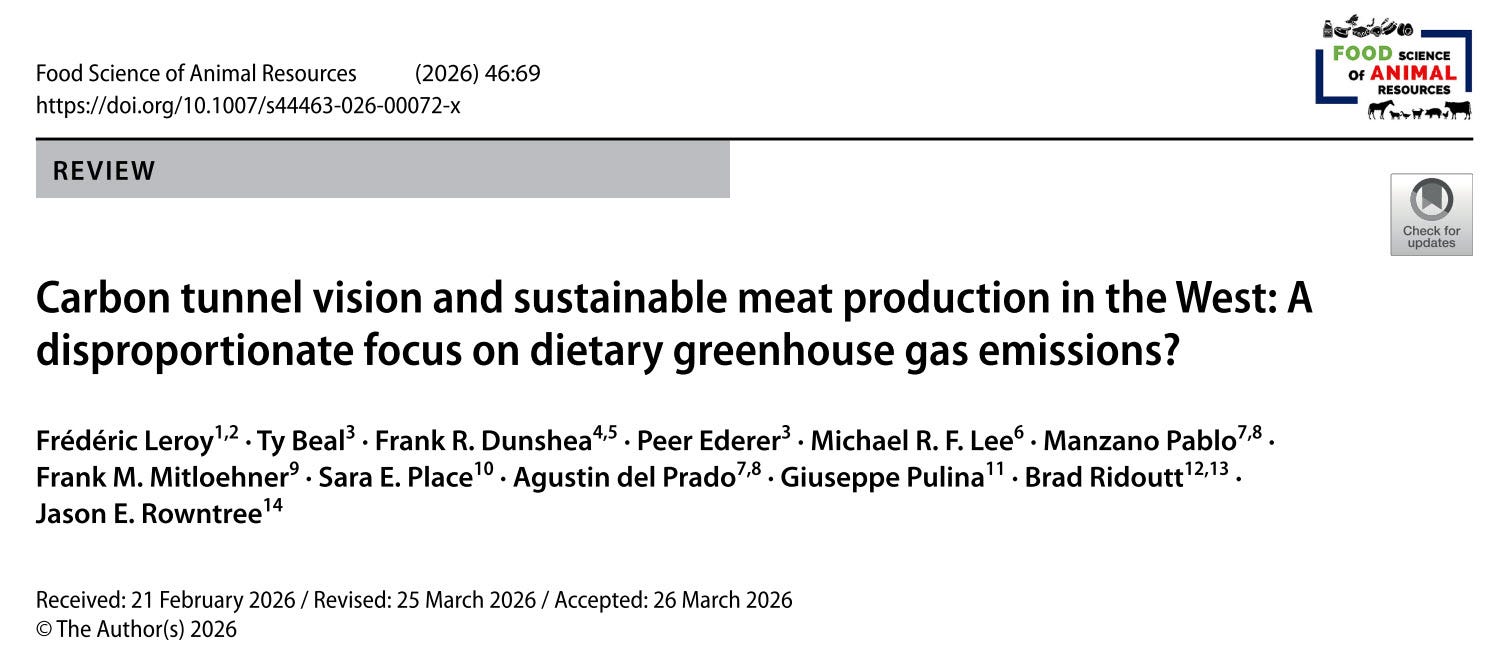
The paper is worth reading because of the breadth of expertise behind it. The author group includes Frédéric Leroy, Ty Beal, Frank Dunshea, Peer Ederer, Michael Lee, Pablo Manzano, Frank Mitloehner, Sara Place, Agustin del Prado, Giuseppe Pulina, Brad Ridoutt, and Jason Rowntree. Collectively, these authors include internationally recognized experts in human nutrition, food science, grazing ecology, greenhouse-gas accounting, life-cycle assessment, animal science, and sustainable livestock systems.1
Their argument is not that livestock systems have no environmental impact. They do. Nor is it that current systems require no improvement. They do. The argument is that public policy becomes distorted when greenhouse gas emissions—especially simplified carbon-equivalent accounting—become the dominant measure by which meat and livestock are judged.
That matters because food systems do not exist merely to minimize emissions. They exist to nourish people.
The paper estimates that all livestock production in the Western nations contributes about 2.6% of total anthropogenic greenhouse gas emissions globally. At the individual level, dietary restriction of animal-source foods may reduce a Western consumer’s total personal carbon footprint by roughly 1–6%, depending on how restrictive and sustained the dietary change is. These figures describe different scales—one global, one personal—but both are substantially smaller than commonly portrayed in public discussions.
The key question is what else is lost, ignored, or miscounted when carbon becomes the mission. Nutrition is an obvious place to start.
Animal-source foods provide dense, bioavailable nutrition: high-quality protein, essential fatty acids, minerals, vitamins, and other compounds that are often harder to obtain from plant-source foods alone. They are especially important for children, pregnant women, older adults, and people already metabolically compromised.
That last category is not small. In the United States, only 6.8% of adults were estimated to have optimal cardiometabolic health in 2017–2018.2 In other words, less-than-optimal cardiometabolic health is nearly universal. A food-system discussion that treats animal-source foods only as emissions sources, while ignoring malnutrition-driven chronic disease, is not doing a full cost-benefit analysis. The costs of poor nutrition must be counted alongside the costs of food production.
Poor public health has costs, too. As Leroy notes in the accompanying discussion, poor public health may itself function as a “carbon multiplier,” increasing the environmental burden associated with chronic disease. Chronic disease carries economic, social, and human costs as well as environmental ones. It requires hospitals, pharmaceuticals, transportation, medical devices, and long-term care. It reduces productivity, strains public finances, burdens families, and diminishes quality of life. If we are willing to count the emissions associated with producing food, we should also be willing to count the consequences of getting human nutrition wrong.
That is the point of resisting carbon tunnel vision.
If we are willing to count the emissions associated with producing food, we should also be willing to count the consequences of getting human nutrition wrong.
A serious food-system analysis must include greenhouse gases, but also nutrition, land use, biodiversity, water, soil carbon, livelihoods, regional differences, methane accounting, co-products, and the ability of ruminants to convert non-human-edible biomass into highly nourishing food.
The world is not a spreadsheet. Food policy should not be either.
References
Paper
Leroy, F., et al. 2026. Carbon Tunnel Vision and Sustainable Meat Production in the West: A Disproportionate Focus on Dietary Greenhouse Gas Emissions? Food Science of Animal Resources 46:69. https://doi.org/10.1007/s44463-026-00072-x
Podcast
FarmGate: Is Carbon Tunnel Vision Obscuring Climate Solutions?
Footnotes
Frédéric Leroy — food scientist and professor at Vrije Universiteit Brussel specializing in nutrition, food systems, and animal-source foods.
Ty Beal — global nutrition scientist at Global Alliance for Improved Nutrition focusing on diet quality, micronutrients, and animal-source foods.
Frank Dunshea — Chair of Agriculture at University of Melbourne with expertise in animal growth, nutrition, and food systems.
Pablo Manzano and Agustín del Prado — leading researchers on pastoral systems, grazing ecology, and environmental assessment.
Frank Mitloehner — internationally recognized livestock air-quality and greenhouse-gas scientist at University of California, Davis.
Sara Place — livestock sustainability expert and associate professor with AgNext.
Jason Rowntree — director of regenerative agriculture initiatives at Michigan State University and one of the leading researchers on grazing systems and soil carbon.
O’Hearn, M., B. N. Lauren, J. B. Wong, D. D. Kim, and D. Mozaffarian. 2022. Trends and Disparities in Cardiometabolic Health Among U.S. Adults, 1999-2018. JACC 80(2):138–151. https://www.jacc.org/doi/abs/10.1016/j.jacc.2022.04.046
Do we humans (especially academics) tend to focus on the minutiae? Is it not in our nature to “see the big picture”?
Certainly focusing and measuring “Carbon” changes everything: agriculture, food, energy production etc. It’s classic Heisenberg Principle: whatever you measure you change. Unfortunately the change is perverse because it is the tunnel vision of “Carbon”.
Thanks for posting this to raise awareness.