

Picking Up the Hammers Again
There's more to nourishment than nutrients

My post on Crude Protein and the variability of plant biomass feed/food value has been delayed. My excuse is that I spent last weekend reconnecting with a part of my life that has been dormant for several years. The several years have been spent writing and speaking about forages, grasslands, ruminants, food systems, human nutrition and metabolic health. But I’ve been reminded that there are many ways we can be nourished beyond “just” nutrients.
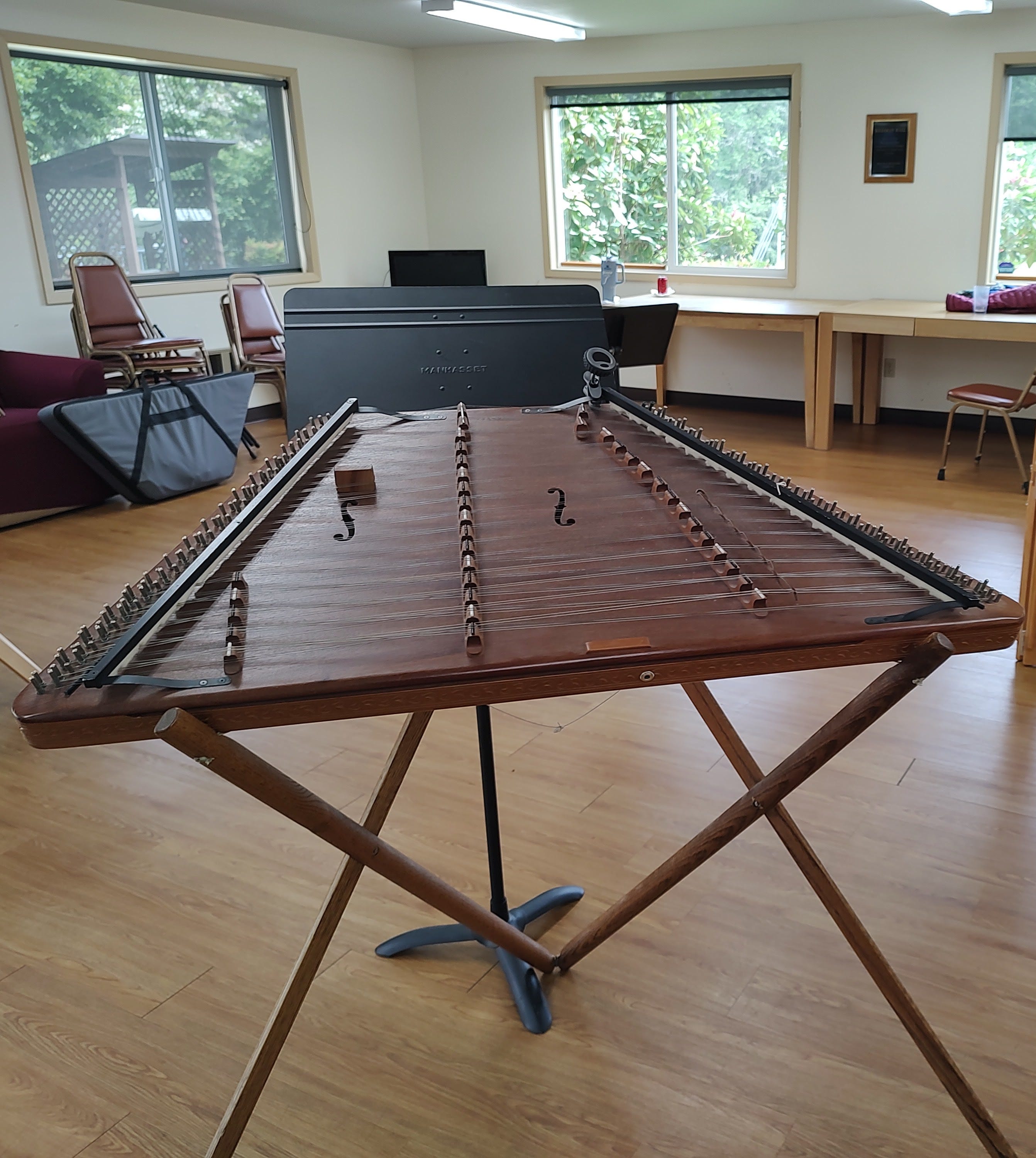
A brief history
In 1996, I believe, I purchased my Whamdiddle hammer dulcimer from Rick Fogel. How I came to be aware of the hammer dulcimer is perhaps a topic for another post.
Given its ancient beginnings and yet still somewhat obscure status, there’s a number of origin stories and historical narratives. So it’s with some hesitation that I offer the following, knowing that I may be inviting some “Well, ACT-shually” responses. (Beginning with the “Is it ‘hammer’ or ‘hammered’?” controversy. I prefer hammer. I have my reasons.)
The hammer dulcimer belongs to one of the oldest and widest-spread families of stringed instruments. These instruments consist of wires stretched across a resonant soundboard, arranged over bridges. It’s played primarily by striking the strings with small handheld hammers rather than by plucking or bowing them. (Some players DO occasionally pluck, bow, mute, or bend the strings while playing, adding tonal color, sustain, texture, and expressive variety beyond the dulcimer’s characteristic struck sound.) There are many related instruments: the Persian santur, Indian santoor, Chinese yangqin, Hungarian cimbalom, German hackbrett. The English form is the most common in North America (they call it “dulcimer” - not to be confused with the Appalachian dulcimer). Its exact origin is debated, but the ancient Near East or Persia between roughly 500 BCE and 1000 CE seems likely.
The hammered dulcimer arrived in North America with European colonists during the 18th century, probably through multiple immigrant streams. By the late 1700s and early 1800s the hammer dulcimer was clearly established in American folk life, particularly in Pennsylvania, New York, New England, and later the Midwest.1 Among its regional nicknames are ‘the lumberjack’s piano’ and the ‘whamadiddle,’ especially in traditions associated with Michigan, Wisconsin, Minnesota, and Ontario timber camps. It was portable, loud enough for dances, mechanically simple, and capable of both melody and rhythm so it fit camp entertainment culture well.
By the early 1900s hammer dulcimers appeared in Sears and Montgomery Ward catalogs, but several factors were leading to the instrument’s decline in popularity. In the 1920s Henry Ford became deeply interested in preserving what he considered “old-time American music” which briefly revived awareness, but the decline continued. There were, fortunately, regional pockets where the tradition was maintained until the 1960s Folk Revival brought some of the remaining players to wider audiences, resuscitating the instrument.
My links


Rick Fogel and Mick Doherty are my links to this tradition. I met Rick first and he introduced me to the Pacific Northwest hammer dulcimer community. I started taking lessons from Mick shortly after that. Mick became my “musical sponsor,” and I consider them both friends.
In 2000 I founded a hammer dulcimer festival that, following two changes in location and a slight name change, still continues.


Following the ‘03 event at Silver Falls State Park near Salem, Oregon, Mick took me on a search for a better location. We found the Oral Hull Park outside of Sandy, OR. Its a wonderful facility and the event, now called the Hammer Dulcimer Rendezvous, has been there ever since. Over the years the instructors have included most of the finest hammer dulcimer musicians in North America. People come from across the country to attend this unique event and the community that’s formed among them gives the event the feeling of a reunion—a rendezvous, you might say…
A regret
So we finally get to the point of this post (beyond an excuse for not getting the Crude Protein post written)!
Here’s a link to the closing group of tunes from ‘09 instructors’ concert that I got to perform with some of the top hammer dulcimer players. This was a personal highlight. Beginning in 2011 my role in the Rendezvous declined due to a job change. Mick agreed to take the lead. I still attended a few more, but at some point I stopped attending. My excuse included schedule conflicts, but I was neglecting the musical “part” of my life that had developed. I haven’t picked up my hammers for years—so many I can’t recall. I’ve said I wanted to “get back to it,” but took no action until this past week.
Nourishment
As critical as nutrition is, there’s more to nourishment than “just” nutrition. Some describe humans as “the musical ape.” Daniel Levitin’s book This Is Your Brain on Music and other works should inform us that music can and should play an important part of our lives. I’ve neglected my music and all that it taught me.
Humans require community. I’ve neglected these friendships.
I’ve made a decision to re-engage with my dulcimer and with these people. The first tangible action I’ve taken was attending the ‘26 Hammer Dulcimer Rendezvous. The ‘27 ‘vous will be May 13-16. Ken Kolodner will be there. It’s on my calendar.
Check with me to see how I’m progressing on this decision.
Meanwhile, here’s the closing set from the Saturday evening concert: “Wayfaring Stranger” performed by Brenda Hunter, Patti Amelotte, and Simon Chrisman.
Modern life can encourage us to reduce nourishment to nutrients, health to biomarkers, and productivity to output. But humans have always required more than fuel.
I hope you’re nourishing yourselves.
Groce, N., 1983. The Hammered Dulcimer in America, Smithsonian Institution Press
Well! I always learn something new from you, and now I’ve learned something wholly unexpected, I don’t believe I had ever even heard of a hammer/ed dulcimer before today lol. Very pretty music, I can certainly see the appeal! Thanks for sharing…
Thank you for sharing about rekindling your musical talent in community.