

We Heterotrophs
Life eats life

The Sanskrit phrase "jīvo jīvasya jīvanam" (जीवो जीवस्य जीवनम्)1 can be translated as “one living being is the sustenance of another.” While the dating is uncertain (Sanskrit traditions were transmitted orally long before their final written compilation 1,000 years ago), the idea itself — that living beings subsist upon other living beings — is deeply embedded throughout ancient Indian thought. A suitable interpretive translation is “life eats life.”
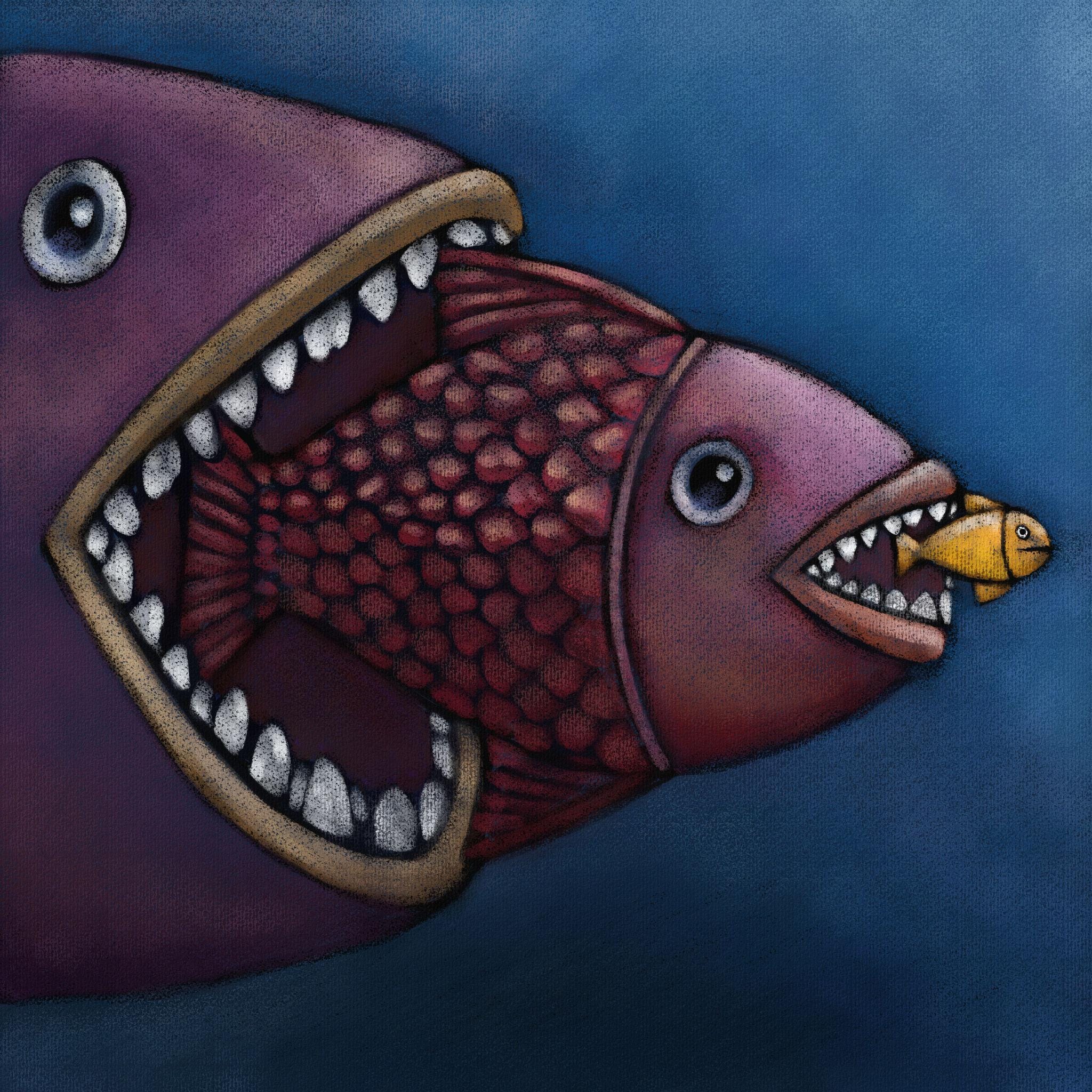
Big fish eat little fish
[One of the books I recommend is Lierre Keith’s The Vegetarian Myth: Food, Justice, and Sustainability (US Amazon link). Keith provided key insights that I hope have informed my efforts. This heading is what her medical provider told her at a critical point in her life. Substack won’t let me footnote a header.]
At the most fundamental ecological level, life can be divided into organisms that produce organic matter from inorganic inputs (autotrophs) and organisms that must consume already-living matter or its products (heterotrophs).
Autotrophs capture external energy and build biomass.
Heterotrophs survive by consuming that biomass, directly or indirectly.
Autotrophs are the primary biological reducers of atmospheric carbon dioxide, while heterotrophs primarily obtain energy through oxidation of organic carbon compounds.
As discussed in the last post, the vast majority of the plant growth on land (the terrestrial Net Primary Production) is plant structural biomass, not human food. Likewise, most of the agricultural plant growth (the Human Appropriation of Net Primary Production) is also inedible to humans because it is fibrous, lignified, chemically defended, or otherwise nutritionally inaccessible without microbial, mechanical, thermal, or industrial transformation. This is the ecological opening occupied by ruminants and other herbivores: they convert otherwise human-inaccessible plant biomass—especially perennial grasses, forbs, crop residues, and byproducts—into high-quality human food and other products.
Humans are heterotrophs. We cannot hold our hands up to the sun and get a sweet taste in our mouths (we can’t photosynthesize). Contrary to the pronouncements of Breatharianism, we cannot live without food by subsisting on “prana,” “life force,” sunlight, air, or spiritual energy. While they’re admittedly a fringe group, misperceptions of basic ecological principles, food system fundamentals, and human nutrition are widespread.
Trophic misunderstanding
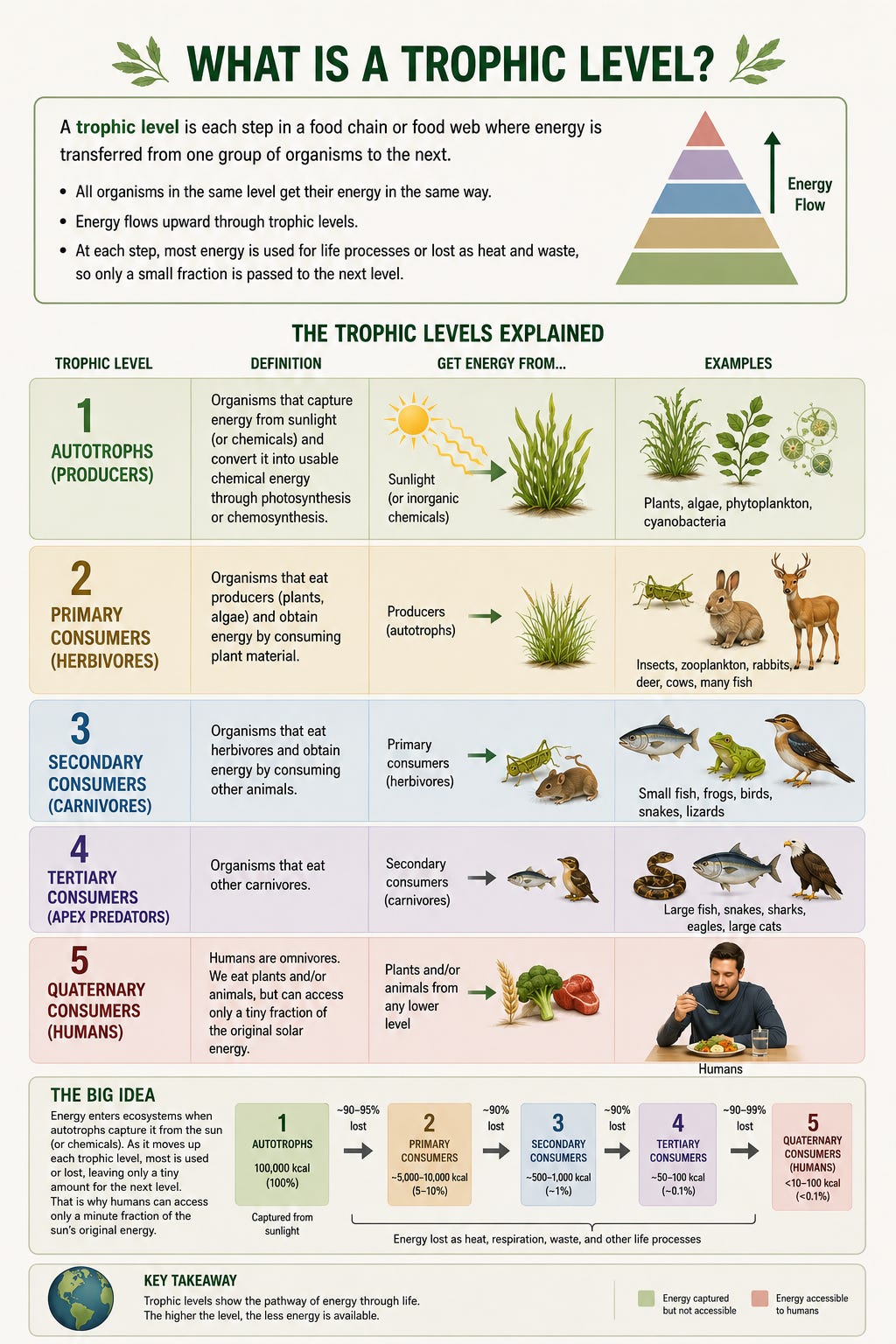
Ecological concepts can be misapplied. Take trophic levels, for example. Each step of a food chain or food web where energy is transferred from one group of organisms to the next is a trophic level. Some have used this to argue for vegan, vegetarian, and so-called plant-based diets.2 It’s true that most of the energy in the biomass consumed by the primary consumers (herbivores) supports maintenance or is lost as heat or waste (e.g. dung and urine) rather than growth or lactation. It’s also true that a similar loss occurs at each subsequent step. Based on this fundamental principle people frequently argue that humans should, essentially, eat the plants and skip the herbivores. But these arguments frequently ignore the equally fundamental fact that most plant biomass is inedible to humans. They also ignore the fact that the amount that is edible is of significantly lower nutritional quality.
“Protein”
These ecological misunderstandings did not remain confined to academic theory. During the 1970s they increasingly shaped public discussions about food, agriculture, nutrition, and environmental responsibility. Among the most influential examples was Francis Moore Lappé’s Diet for a Small Planet (US Amazon link). It was actually cited in the 1977 U.S. Senate “Dietary Goals” report. Several of its central claims, however, rested upon oversimplified or weakly supported assumptions that were already scientifically contestable at the time of publication. These included treating “protein” largely as a quantitative commodity rather than distinguishing protein quality, digestibility, amino acid balance, and nutrient bioavailability; portraying livestock primarily as competitors with humans for food while giving insufficient attention to non-arable land, forage-based systems, coproduct utilization, and nutrient cycling; reducing the nutritional role of animal-source foods largely to crude protein equivalence. Many of these errors still persist.
[I’ve spoken about protein in human nutrition here and here, and it’s on my list for future posts]. Later advances in nutrition science, developmental biology, and systems ecology further weakened these assumptions, while the author herself subsequently acknowledged that her treatment of protein complementarity had reinforced “misconceptions.” And yet it remains an influential book. [For anyone whose childhood was scarred by it, I apologize for rekindling the unpleasant memories. Mine includes a watery soybean casserole topped with Velveeta cheese…]
“Other that THAT…”
A 2018 evaluation of the United States’ beef systems showed that beef is a net contributor to meeting human protein requirements—they produce more human-edible protein than they consume.3 In those parts of the world where cattle are fed no human edible feed at all, of course, this metric becomes literally incalculable—you can’t divide by 0.
Some, including Lappé, persist by relying on environmental arguments as their justification. For them, let me offer this paper that was just published.4
Take home ideas
Humans cannot eat sunlight.
We cannot digest most of the plant biomass produced on Earth.
We remain dependent upon organisms capable of transforming landscapes, cellulose, atmospheric carbon, minerals, and microbial metabolism into forms we can actually use.
We heterotrophs always will.
Thanks to Mark Rhodes for this (and so much more!).
FAO data documents that humanity’s food supply is already plant-based. The existence of widespread, if poorly recognized, malnutrition isn’t discussed.
See Baber, J. R., J. E. Sawyer, and T. A. Wickersham. 2018. Estimation of human-edible protein conversion efficiency, net protein contribution, and enteric methane production from beef production in the United States. Translational Animal Science 2(4):439–450. https://academic.oup.com/tas/article/2/4/439/5050230
Leroy, F., T. Beal, F. R. Dunshea, P. Ederer, M. R. F. Lee, P. Manzano, F. M. Mitloehner, S. E. Place, A. Del Prado, G. Pulina, B. Ridoutt, and J. E. Rowntree. 2026. Carbon tunnel vision and sustainable meat production in the West: A disproportionate focus on dietary greenhouse gas emissions? Food Science of Animal Resources 46(1) https://link.springer.com/article/10.1007/s44463-026-00072-x
Excellent summary!