



We talk a lot about food. Food production. Food security. Food prices. Food waste. Food policy. Sustainable food. Food systems. But what is food?
That may sound like a silly question. Surely we all know food when we see it. Or do we?
Before asking what kind of food system is sustainable, perhaps we should first ask a more fundamental question: What must that system accomplish?
Surely a food system must first nourish human beings. Which leads to another deceptively simple question: What does “nourish” mean?
What do you mean by “meat”?
Even the names we give foods aren’t as straightforward as we might think. Ask people from different cultures how often they eat “meat” and you may get very different answers—not simply because their diets differ, but because meat may mean different things to them. Someone might tell you that meat is eaten only occasionally: on Sunday, at a celebration, when guests visit, or on some other special occasion. Yet that same person may consume some form of muscle or variety meat every day. Small amounts of meat, fresh or processed, may be incorporated into soups, stews, sauces, or mixed dishes. But that isn’t necessarily what the person means by “meat.” Eggs, milk, cheese, fish, or other animal-source foods may be seen more as ingredients, too.
The special piece of meat at the center of a celebratory meal is meat. The animal-source foods incorporated into everyday meals may simply be food. Language matters. Culture matters. And food is deeply cultural.
Think about the foods associated with your own childhood. What did your family eat at holidays? What was served when relatives came to visit? What dishes did your parents or grandparents prepare? Which foods immediately remind you of particular people, places, or events? Recipes pass between generations. So do techniques for growing, harvesting, preserving, fermenting, curing, cooking, and serving foods.
Food carries history. Food expresses hospitality. Food accompanies celebration and mourning. Food is associated with religious observance, geography, seasons, livelihoods, and community.
So already our definition is becoming more complicated. Food is something humans eat. But food is also something humans do.
Take a walk through the supermarket
Now consider a typical American supermarket. Walk around the outside. Produce, meat, eggs, dairy, seafood. The perimeter isn’t a perfect dividing line. The bakery and deli may be there as well. Meanwhile, frozen vegetables, canned fish, coffee, and many other recognizable foods are found in the interior aisles. But walk those center aisles and something changes. Boxes, bags, bottles, cans, and jars. Some contain foods that have simply been preserved or packaged. Others contain products assembled from ingredients that have been extracted, refined, fractionated, concentrated, recombined, flavored, colored, stabilized, emulsified, and packaged. And we call all of it “food.”
Estimates suggest that roughly 70 percent of the U.S. food supply consists of products commonly classified as ultra-processed (a category that may be a topic for another time). More than half of the calories consumed by American adults—and an even greater proportion of those consumed by children and adolescents—now come from ultra-processed foods.
I’m not suggesting that processing is the problem. Humans have processed food for a very long time. We cook, grind, dry, smoke, ferment, and cure. We transform milk into cheese or we separate the cream and churn it into butter. Traditional food cultures are, in part, collections of technologies for transforming biological materials into foods that are safer, more digestible, more storable, more nutritious—or simply more delicious.
But there seems to me to be a meaningful distinction between processing food and manufacturing an edible product.
Which raises our question again: What is “food”?
Edible biomass
I’m an agronomist, so perhaps I approach this question differently. Agriculture produces biomass. In fact, I’ve come to describe agriculture this way:
The history of agriculture is the story of humanity modifying its environments to produce more edible biomass.
Takes some of the romance out of it, doesn’t it? Perhaps “edible” is where some of the confusion begins, since edible biomass and food aren’t necessarily synonymous. A substance can be edible and provide calories while failing to provide adequate essential nutrition. Likewise, two foods providing the same number of calories may not be nutritionally equivalent. Nor are two foods containing the same number of grams of “protein.” Protein isn’t just protein.
Human beings require particular amino acids. Their amounts matter. Their proportions matter. Digestibility matters. Bioavailability matters. The same is true of minerals, vitamins, essential fatty acids, and other nutrients. Animal-source foods aren’t simply sources of protein. They provide a veritable basket of highly bioavailable essential nutrients.
And even that description may be incomplete. There is evidence for a “meat factor,” for example: eating animal-source foods can improve the utilization of nutrients such as iron and zinc from other foods in the same meal. Foods interact. Meals matter. Reducing foods to their individual nutrients can obscure something important about food itself.
From adequacy to “negative nutrition”
During my presentation at the Symposium for Metabolic Health, I showed this American nutrition poster from 1943.
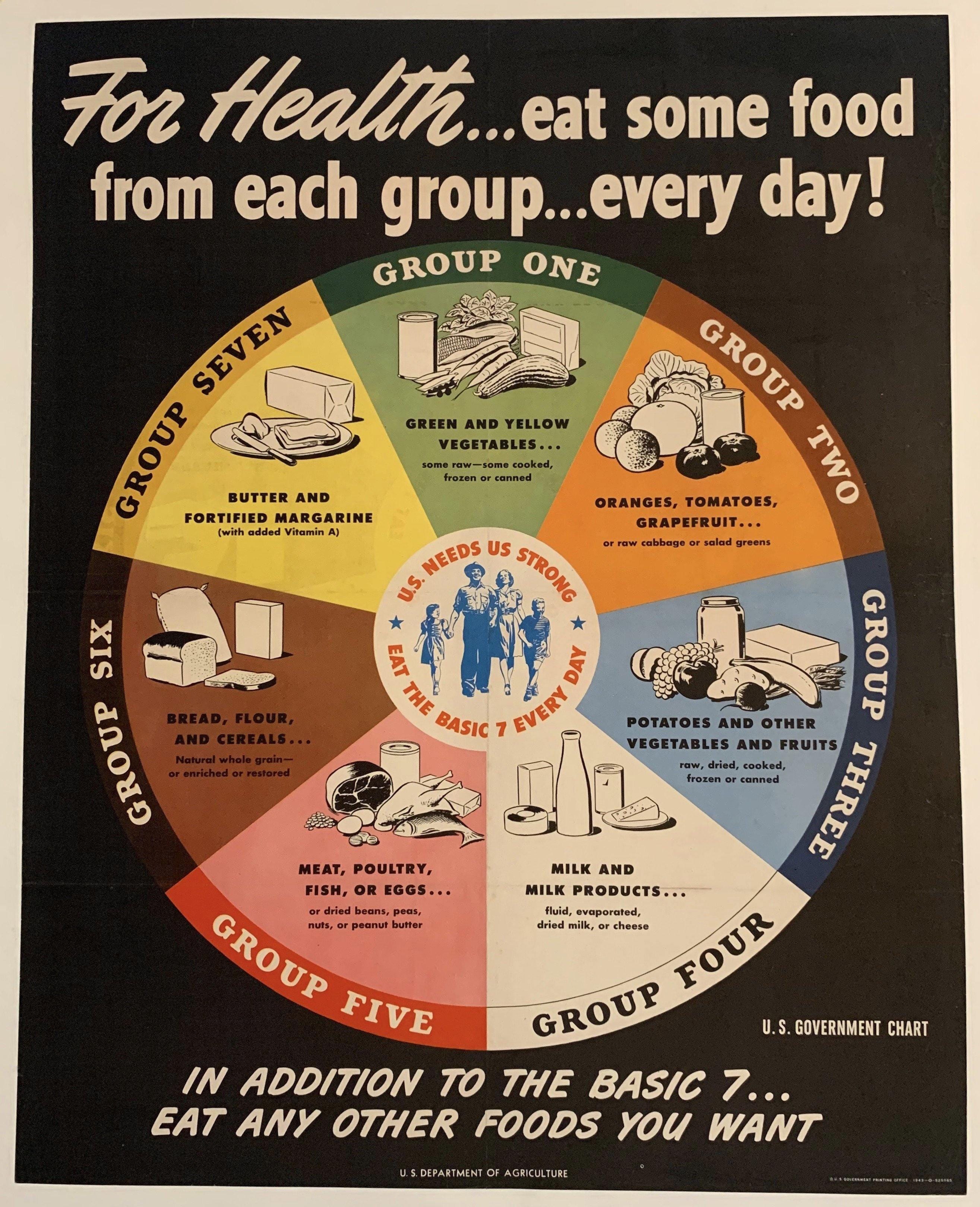
Its message seems almost quaint today: “For health, eat some food from each group every day.”
The question underlying that advice was essentially: “What must people eat to be adequately nourished?” Nutrition was concerned with adequacy. Later, the emphasis changed. Adele Hite called what followed “negative nutrition.”
Instead of asking primarily what people needed to eat, nutrition increasingly told us what to eat less of.
Fat. Then saturated fat.
Cholesterol.
Meat and other animal-source foods.
Salt.
Sugar.
The dominant question had changed from “What do we need?” to “What should we avoid?” At the same time, the scale and nature of our malnutrition problem were changing. Classical nutrient deficiencies certainly haven’t disappeared. They remain an enormous burden in many parts of the world—and within populations in affluent nations. But we now coexist with another enormous problem: chronic metabolic dysfunction, manifesting as obesity, type 2 diabetes, cardiovascular disease, fatty liver disease, and a growing collection of other disorders associated with impaired metabolic health.
People can consume an abundance of edible material—an abundance of calories—and still be poorly nourished. Overfed but undernourished. Even malnourished. That possibility should fundamentally change the way we think about food systems.
Nutrients aren’t nourishment
I don’t want to make the opposite mistake. If food isn’t merely calories, neither is it merely a more sophisticated list of nutrients. Nutrition science has taught us a great deal by taking foods apart—identifying and understanding their proteins, fats, carbohydrates, amino acids, fatty acids, vitamins, minerals, and other components. That knowledge matters. But people don’t eat nutrient tables. We eat foods. We eat meals. And hopefully, we share many of those meals with other people.
A shared meal can nourish something that isn’t measured in grams or milligrams. Food connects generations. It reinforces families and communities. It gives us occasions to gather. It preserves knowledge and carries traditions forward. It connects people with particular plants, animals, landscapes, and seasons. It provides livelihoods.
There is more to nourishment than nutrients.
A nutritionally complete formulation consumed alone might satisfy every biochemical requirement we can currently measure. Would we really consider that the full meaning of being nourished? I wouldn’t.
We need nutrients. But we are nourished by food.
What is the purpose of a food system?
This matters because the answer determines what we mean by a “sustainable food system.”
We measure agricultural systems in all sorts of ways.
Yield per hectare.
Kilograms of food.
Calories.
Grams of protein.
Water use.
Land use.
Greenhouse-gas emissions.
Those measurements can be useful, but for what? Every measure contains, explicitly or implicitly, an assumption about what the system is supposed to accomplish. If the objective is producing the greatest quantity of edible biomass, one agricultural system may appear optimal. If the objective is calories, another may. If we measure crude protein, we may get another answer. If we ask about digestible indispensable amino acids, the ranking may change. If we ask about providing the complete basket of essential nutrients humans need in bioavailable forms, it may change yet again. And if the objective is human nourishment and flourishing, the accounting becomes more complicated still.
Now we must ask what happens after something leaves the farm. Production isn’t provision. Agriculture produces commodities. Those commodities enter systems of processing, distribution, marketing, retail, food service, cooking, and consumption.
What does the agricultural commodity eventually become? Who can afford it? Who has access to it? What does it replace in the diet? What happens metabolically when people consume it? Does the resulting diet improve health—or contribute to disease? And what happens to the families, communities, livelihoods, traditions, and landscapes associated with producing and eating it?
If the purpose of a food system is to nourish people, why should our assessment of that system stop at the farm gate, processing plant, supermarket checkout—or dinner plate?
Most biomass isn’t food—for us
There is another complication. Most of the plant material produced on Earth, even that produced by agriculture, isn’t edible by humans. A grass-covered hillside is producing phytomass. But it’s not producing human food, at least not directly. We can’t eat grass but a cow can. More precisely, ruminants and the extraordinary microbial ecosystem contained within their rumens can. Ruminants consume fibrous plant material humans cannot digest and transform it into foods we can digest—foods providing highly digestible protein with the indispensable amino acids humans require, along with fatty acids, vitamins, minerals, and other nutrients. They can utilize grasslands unsuitable for crop production, as well as forages, crop residues, and by-products from other parts of our agricultural and food systems.
I’ve sometimes called them Ruminant Rumpelstiltskins. They don’t quite spin straw into gold. But transforming human-inedible biomass into nutrient-dense human food is an impressive trick. And it exposes a problem with the way we sometimes think about food-system efficiency.
If we count kilograms of material consumed by an animal without distinguishing between things humans can and cannot eat, are we measuring competition for food?
If we compare kilograms of crude protein without accounting for amino-acid composition, digestibility, and bioavailability, are we measuring nutritional output?
If we compare environmental impact per calorie while treating calories as nutritionally interchangeable, are we measuring the thing we actually care about?
Or are we answering the wrong questions very precisely?
What are we trying to sustain?
During my presentation I suggested turning a familiar sustainability question around.
Instead of beginning with:
How much animal-source food can a sustainable food system tolerate?
begin with:
What food system can sustainably provide the nourishment required for human health?
Only then should we ask how to produce it.
“Can we produce it?” should not logically precede “What do people need?”
That doesn’t make the production question disappear. Quite the opposite. It makes it an obligation.
If metabolic-health science tells us that the foods people require differ from what our current food system is designed to provide, then “we can’t feed the world that way” isn’t the end of the conversation. It’s the beginning of one. We have to figure out how.
That will require agriculture, nutrition, medicine, ecology, food processing, distribution, retail, economics, and policy to talk to one another. And we’ll have to be careful about assumptions moving from one discipline into another disguised as established facts.
Most importantly, we’ll need to agree about what we’re trying to accomplish.
From edible biomass to nourishment
The history of agriculture is the story of humanity modifying its environments to produce more edible biomass. That achievement made civilization possible. But producing ever more edible biomass cannot be our only objective for the future. Not when societies awash in calories are simultaneously burdened by metabolic disease. Not when essential nutrient inadequacies remain widespread. Not when much of what fills our supermarkets would have been unrecognizable as food to our grandparents. And not when food means more to human beings than its nutrient composition. So perhaps the next chapter should be different:
The future of agriculture must be the story of producing better nourishment.
Which brings us right back to where we started: What is “food”?
Love this article is very thoughtful, copy and translate to Swedish for my farmer sister, she is my hero, so hardworking and her mission is to produce REAL food to people, egg, meat, milk. She does not get any medals here In Sweden, rather the opposite.