

Bison
What's known about Pre-Columbian North American Bison?

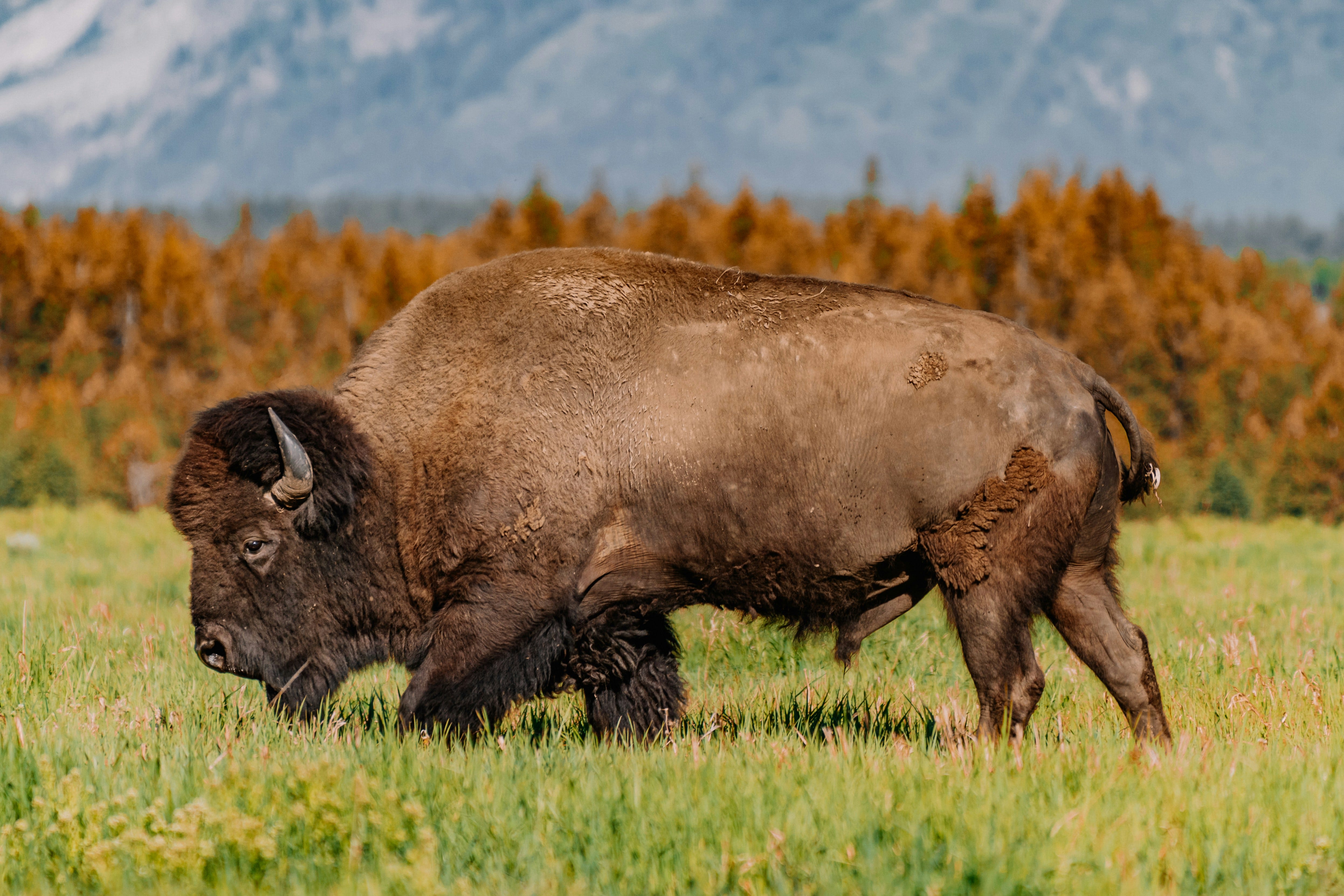
November 1st was National Bison Day (the first Saturday of November). Perhaps the month should start with a bison roast and end with roast turkey. I’d incorrectly set a calendar reminder for today (the 4th), which prompted me to start this post, but then I realized my mistake. Oh, well…
One of the books I highly recommend is Charles C. Mann’s 1491: New Revelations of the Americas Before Columbus (US Amazon link, not an Amazon Associate). Mann introduced me to the many significant differences between the scholarship and the popular misconceptions of the Pre-Columbian Americas. One of the many memorable passages seems appropriate to this occasion:
“The post-Columbian abundance of bison,” in his [Valerius Geist’s] view, was largely due to “Eurasian diseases that decreased [Indian] hunting.”1 The massive, thundering herds were pathological, something that the land had not seen before and was unlikely to see again.
Recalling this prompted me to do a little research into the scholarship regarding the National Mammal of the USA.
Ancient DNA and fossil studies23 demonstrate that bison entered North America between 195,000–135,000 years ago and underwent repeated expansions and contractions in response to glacial–interglacial cycles. These shifts indicate that bison abundance was dynamic rather than static.
By the mid-Holocene (roughly 9,000 to 5,000 years ago), bison occupied prairies, steppe, and parklands across most of North America—from Alaska to northern Mexico, and from the Rocky Mountains to the eastern tallgrass prairie. The wood bison of the boreal north and the plains bison of the Great Plains represented adaptations to distinct environments. Population densities varied dramatically across regions.
Climate modeling shows that cold-season temperature, snow depth, and drought cycles were the primary constraints on bison habitat.4 These factors caused local extinctions and recolonizations over millennia, making continent-wide continuous herds climatically impossible.
For over 12,000 years, Indigenous peoples coexisted with and managed bison through patterned burning and selective hunting. Fire created nutrient-rich regrowth that attracted grazers and maintained patchy grassland mosaics. Archaeological evidence shows repeated communal hunts at known bottlenecks, implying predictable, locally resident herds.56
Stable isotope analyses of mid-Holocene bison teeth indicate seasonal movements of less than 100 km, suggesting local residency rather than long-distance migration.7 Bison tracked fire and forage cycles, moving flexibly within regional ecological neighborhoods.
Over the late Holocene, warming temperatures correlated with smaller bison body sizes. This likely reflects declining forage quality and reduced carrying capacity, contradicting assumptions of uniformly vast populations.
Historical accounts of massive herds across the Plains likely describe a temporary ecological release following the collapse of Indigenous populations after the Columbian Exchange. With fire suppression and hunting disruption, bison populations expanded briefly into new areas. These ‘super-herds’ were a symptom of imbalance, not the pre-contact norm. Pre-Columbian grasslands were human-shaped ecosystems. Restoration of bison today should emphasize dynamic, mosaic landscapes and incorporate Indigenous ecological knowledge rather than attempting to recreate mythical ‘endless herds.’
Mann cites Geist, V. 1998. Buffalo Nation: History and Legend of the North American Bison. Stillwater, MN: Voyageur Press.
Froese, D., et al. (2017). Fossil and genomic evidence constrains the timing of bison arrival in North America. Proceedings of the National Academy of Sciences of the United States of America, 114(13), 3457–3462. DOI: 10.1073/pnas.1620754114
Heintzman, P. D., et al. (2016). Bison phylogeography constrains dispersal and viability of the Ice-Free Corridor in western Canada. Proceedings of the National Academy of Sciences of the United States of America, 113(29), 8057–8063. DOI: 10.1073/pnas.1601077113
Wendt, J. A. F., et al. (2022). Large-scale climatic drivers of bison distribution and abundance in North America since the Last Glacial Maximum. Quaternary Science Reviews 284:107472. DOI: 10.1016/j.quascirev.2022.107472
Wilson, M. (1978). Archaeological Kill Site Populations and the Holocene Evolution of the Genus Bison. Plains Anthropologist 23(82):9–22. DOI: 10.1080/2052546.1978.11908896
Bamforth, D. B. (1987). Historical Documents and Bison Ecology on the Great Plains. Plains Anthropologist 32(115):1–16. DOI: 10.1080/2052546.1987.11909364
Widga, C., et al. (2010). Middle Holocene Bison diet and mobility in the eastern Great Plains (USA) based on δ 13C, δ 18O, and 87Sr/86Sr analyses of tooth enamel carbonate. Quatern. Res. 73(3):449–463. DOI: 10.1016/j.yqres.2009.12.001
Barsh, R. L. and M. Chantelle. (2003). Driving Bison and Blackfoot Science. Hum. Ecol. 31(4):571–593. http://www.jstor.org/stable/4603493
Biondini, M. E., et al. (1999). Bison Use of Fire-Managed Remnant Prairies. Journal of Range Management 52(5):454. DOI: 10.2307/4003772
Davies, G., et al. (2019). Isotopic paleoecology of Northern Great Plains bison during the Holocene. Scientific Reports 9(1). DOI: 10.1038/s41598-019-52873-4
Físhel, R. L. (2000). Bíson Hunters of the western Praíríes. Plains Anthropologist 45(172):224–224. DOI: 10.1080/2052546.2000.11932009
Funck, J., et al. (2020). A detailed life history of a pleistocene steppe bison (Bison priscus) skeleton unearthed in Arctic Alaska. Quaternary Science Reviews 249:106578. DOI: 10.1016/j.quascirev.2020.106578
Martin, J. M., et al. (2018). Bison body size and climate change. Ecology and Evolution 8(9):4564–4574. DOI: 10.1002/ece3.4019
Turpin, S. A. (1988). More Or Less Bison. Plains Anthropologist 33(121):408–409. DOI: 10.1080/2052546.1988.11909406
You say: "warming temperatures correlated with smaller bison body sizes. This likely reflects declining forage quality and reduced carrying capacity,". I would think warming temperatures would increase the quantity and quantity of forage, hence, larger body sizes.
Thanks
Thanks for the interesting article. Looking forward to checking out Charles C. Mann's book.