

'Liebig's' Barrel
Scientific memory and short staves

I learned Liebig’s Law of the Minimum while studying soil fertility more than forty years ago. I didn’t realize then that one day I’d use it to think about human health.
Biological limits
Liebig’s Law of the Minimum states:
Growth, performance, or productivity is limited not by the total amount of available resources, but by the resource that is in the shortest supply relative to the organism’s needs.
A wooden barrel was used to illustrate this.
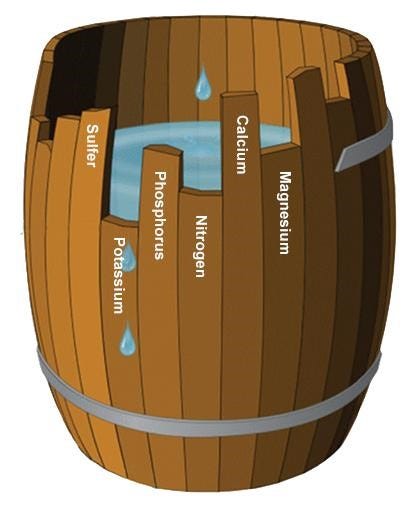
The barrel is made up of staves of differing lengths. The effective volume of the barrel, therefore, will be determined by the shortest stave. Increasing the lengths of the other staves won’t allow the barrel to hold more. In the figure above, the short stave is labeled Potassium (The “K” in N-P-K fertilizer analysis, from the German word Kalium). Since potassium is deficient in this example, adding more of the other elements won’t improve yield.
The barrel isn’t limited to plant nutrition.
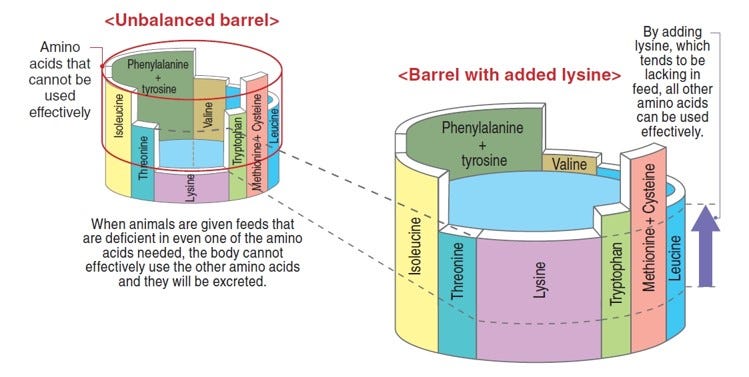
In this figure it’s used to demonstrate the 1st Limiting Amino Acid—how a deficiency in one essential amino acid (in this case Lysine), will limit the body’s use of the others.
1st Limiting Amino Acid -
The essential amino acid found in the shortest supply relative to the amounts needed for protein synthesis in the body. Four amino acids are most likely to be limiting: lysine, methionine, threonine, tryptophan.
Since protein feeds are typically more expensive and poor utilization will lead to environmental impact, swine nutritionists have been balancing their rations accordingly for almost half a century. Human nutrition has been slower to adopt the same quantitative approach to indispensable amino acid requirements.
I’ve used this model to suggest that impaired insulin regulation may be the “short stave” of public health.1 As I discussed in It SOUNDS Good… many folks focus on the longer staves (usually rather poorly defined) in their attempts to improve public health. The Law of the Minimum suggests that if impaired insulin regulation is today’s limiting factor, restoring normal insulin sensitivity would reveal the next constraint, but we’re a LONG way from that point! Until then focusing on those other factors is unlikely to produce significant improvements in the chronic disease burden and is more likely to delay progress.
There’s another lesson we can learn from this example.
Scientific limits
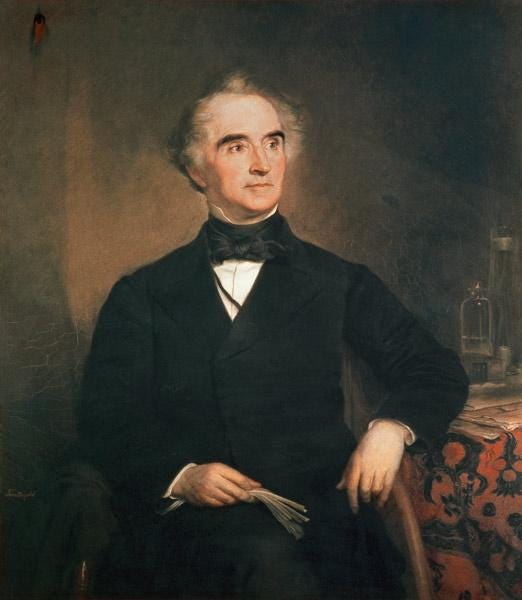
Justus von Liebig was one of the towering figures of 19th-century chemistry. His significance extends well beyond fertilizer. He helped make organic chemistry a systematic experimental science, developed important methods of chemical analysis, and—perhaps most consequentially—created at Giessen a model for laboratory-based graduate education in chemistry that was copied across Europe and the United States.2
Liebig’s 1840 book Organic Chemistry in Its Application to Agriculture and Physiology was enormously influential. His writings stimulated agricultural experimentation and strongly influenced students who later helped establish agricultural experiment stations and agricultural education in the United States (more about that in the future). He was one of the principal architects of agricultural chemistry and a major intellectual ancestor of modern agricultural science. But he did NOT originate the Law of the Minimum!
The stronger historical evidence points to Carl Sprengel (1787-1859). Sprengel, a German agronomist and agricultural chemist, helped establish the mineral theory of plant nutrition. Sprengel published the essential concept in 1828—twelve years before Liebig’s 1840 book:
If a plant requires twelve substances, it will not thrive if even one is absent, and it will grow poorly if one is not present in the amount the plant’s nature requires.
In 1999 a major historical reassessment published in the Soil Science Society of America Journal concluded that Sprengel’s 1828 paper contained, in essence, the Law of the Minimum a decade before Liebig’s influencial work and recommended recognizing him as a cofounder of agricultural chemistry and calling the principle the Sprengel–Liebig Law of the Minimum.3
Despite this recommendation, the principle is still almost universally known as Liebig’s Law of the Minimum. Liebig expanded and popularized the idea—and got his name attached to it. Science, it turns out, has its own limiting factors. Sometimes one of them is recognition.
What’s more, Liebig apparently didn’t create the barrel analogy either!
Meet Arnold von Dobeneck (1867-1926), another German agricultural scientist and editor-in chief of the Illustrierte Landwirtschaftliche Zeitung (“Illustrated Agricultural Newspaper”), a major German agricultural periodical. The original illustration appeared in the October 1903 issue. It appears to have been unconnected to an article and carried only the caption: “Unsere Minimum-Tonne” (“Our Minimum Barrel” or, more literally, “Our Minimum Vat.”) The illustration itself was unsigned. The historical attribution to Dobeneck rests on his role as responsible editor, his known illustration style, and a 1927 obituary specifically noting the popularity of his depiction of Liebig’s principle of plant nutrition.4 Note the attribution to Liebig!
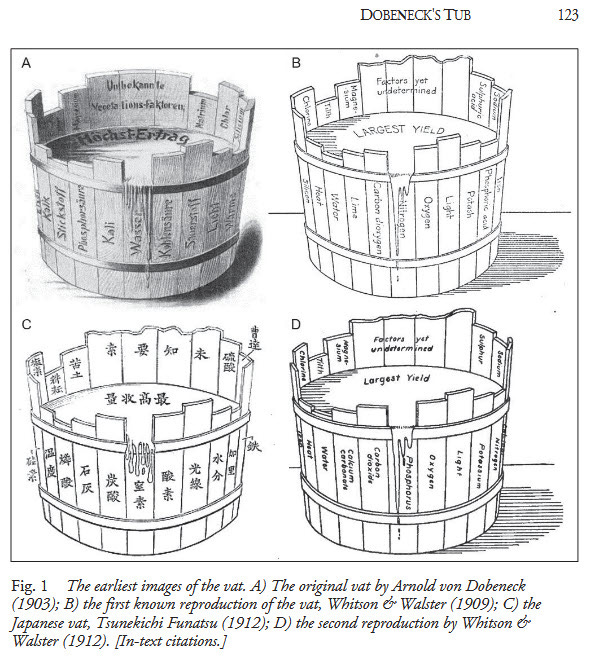
In other words, even the famous “Liebig barrel” appears not to have been Liebig’s.
Public-health limits
Discovery and recognition are not the same thing. Neither is discovery the same as durable incorporation into scientific understanding. Readers of Gary Taubes5 will recognize this pattern in the history of therapeutic carbohydrate restriction: John Rollo (c. 1750–1809), Claude Bernard (1813–1878), William Harvey (1811–1866), and William Banting (1796–1878). Clinical observation, developing physiological understanding, therapeutic application, and popular communication accumulated across generations. Therapeutic carbohydrate restriction has repeatedly emerged, demonstrated clinical success, faded from mainstream practice, and then re-emerged under new names and new advocates. Science doesn’t always advance in a straight line. Sometimes it advances by forgetting something, rediscovering it, renaming it, and eventually understanding why it worked.
Public health may be suffering from two related failures: we have failed to identify the shortest stave, and we have repeatedly forgotten knowledge that might help us lengthen it.
What if impaired insulin signaling and regulation is the shortest stave in the public-health barrel but we keep lengthening the long staves?
More healthcare spending.
More screening.
More pharmaceuticals.
More nutrition education based on a dietary model that has failed to restore metabolic health.
Those things may have value. But if they aren’t the limiting factor, lengthening those staves cannot raise the barrel’s capacity beyond the shortest stave. And some inputs supplied beyond their useful range may cease to be merely uneconomical and become harmful.
That is a very agronomic argument.
Rollo published one of the first systematic descriptions of treating diabetes with a diet centered on meat and severely restricting carbohydrate in 1797. Numerous observations demonstrate that reducing dietary carbohydrate can rapidly improve glycemic control and reduce medication requirements in people with impaired glucose metabolism. The modern conversations about therapeutic carbohydrate reduction are not new. Our mechanistic understanding has advanced enormously, but the fundamental observations are NOT new. The lesson has repeatedly been discovered, forgotten, and rediscovered—and often attributed to the latest promoter.
Agronomists know that crops cannot outgrow their shortest stave. Animal nutritionists know that protein quality depends on the first limiting amino acid. Perhaps public health has been trying to increase the capacity of the barrel by lengthening the wrong staves. If impaired insulin sensitivity is today’s limiting factor, then no amount of extending the longer staves can compensate. Identifying the shortest stave may be the first step toward restoring the health of the whole barrel.
I recommended (and have given away many copies of) Benjamin Bikman’s 2020 book Why We Get Sick: The Hidden Epidemic at the Root of Most Chronic Disease--and How to Fight It (US Amazon link)
Van Der Ploeg, R. R., W. Böhm, and M. B. Kirkham. 1999. On the Origin of the Theory of Mineral Nutrition of Plants and the Law of the Minimum. Soil Sci. Soc. Am. J. 63(5):1055–1062. https://dx.doi.org/10.2136/sssaj1999.6351055x
Pantaleoni, R. A., L. Mariani, G. Ferrari. 2020. Il mastello di Dobeneck. Rivista di Storia dell’Agricoltura, 60(2), 119–132. https://doi.org/10.35948/0557-1359/2021.1769 (English translation via DeepL.com here)
See also Gary Taubes’ Amazon author page and Substack Uncertainty Principles
Great application of this metaphor! And a great way to begin to figure out how to make sense of the endless stream of health and longevity recommendations.
I am visiting with a patient in clinic and he wanted to know what the name of that he wanted to know what the name of that “barrel” representing The limiting nutrient. I showed him your title.