

Building Bridges in Amarillo
Intellectual, not physical

[This was originally supposed to be this week’s post. Then a new paper from Leroy and colleagues landed in my inbox, and I realized that it was National Forage Week. The result is three posts instead of one. Apparently bridge-building occasionally requires detours. Thanks for reading.]
Saturday I’ll be traveling to Amarillo, Texas, for the 79th Reciprocal Meat Conference (RMC), the annual meeting of the American Meat Science Association (AMSA).
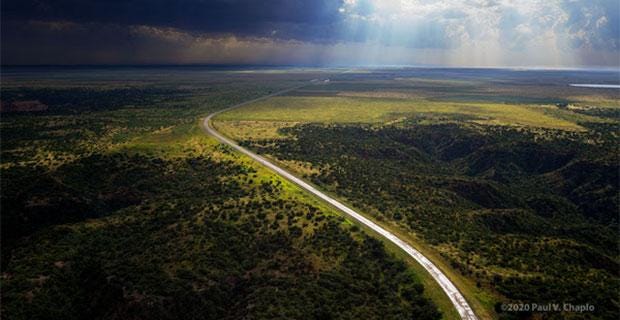
Amarillo sits on the relatively flat southern High Plains. Canyon is slightly more varied because it lies near the eastern edge of the Llano Estacado and serves as the gateway to Palo Duro Canyon. The landscape features plenty of draws, arroyos, and canyons, but relatively few notable bridges compared with places such as Portland, Pittsburgh, or Prague. Amarillo may not require many literal bridges, but I’ll be spending much of the week trying to build a few intellectual ones.
For many readers, “meat science” may sound like a narrow specialty concerned with processing plants, carcass grading, or food technology. In reality, it is a remarkably broad discipline that sits at the intersection of animal agriculture, biology, nutrition, physiology, food science, engineering, economics, and human health.
As someone whose professional journey began in forage agronomy and ruminant nutrition before expanding into human nutrition and metabolic health, I find meat science to be one of the most important—and least understood—disciplines in agriculture.
What Is Meat Science?
At its core, meat science seeks to understand how living muscle becomes food. The discipline encompasses genetics, animal nutrition, growth, physiology, welfare, muscle biology, carcass evaluation, meat quality, food safety, processing, consumer preferences, and nutritional composition.
Many of the leading meat science programs are housed within America’s land-grant universities. Institutions such as Texas A&M, Iowa State, Kansas State, Oklahoma State, Texas Tech, North Dakota State, South Dakota State, Nebraska, Illinois, Purdue, and others have trained generations of scientists who have improved livestock production, food safety, meat quality, and our understanding of animal-source foods.
The field is inherently interdisciplinary. One meat scientist may study muscle fiber development. Another may focus on protein chemistry, food safety, sensory evaluation, lipid oxidation, consumer behavior, or nutritional value. Yet all are ultimately working toward a common objective: How do we produce more and better food from animals?
Why “Reciprocal”?
Even the conference’s name reflects a tradition of bridge-building. Most people outside the profession—and perhaps many within it—have never stopped to ask why it is called the “Reciprocal” Meat Conference. The term dates to the early years of meat science education, when universities took turns hosting the annual meeting. Faculty members, researchers, and students traveled from institution to institution, with each host school reciprocating the hospitality and participation previously received from others. The conference has not been associated with a permanent venue. Instead, it functions as a cooperative exchange among university meat science programs.
The name reflects a tradition of shared scholarship, mutual professional support, rotating responsibility, and the exchange of ideas. In that sense, bridge-building has been part of the conference’s identity from the beginning. My own participation this year reflects a similar spirit of reciprocity—not between universities, but between disciplines. Agriculture has much to learn from medicine and metabolic science, just as medicine has much to learn from agriculture and food production.
The Reciprocal Meat Conference
The Reciprocal Meat Conference has been held annually for nearly eight decades and serves as the principal gathering of the American Meat Science Association.
Researchers, educators, students, veterinarians, processors, producers, and industry leaders gather to discuss the latest developments in meat science and muscle biology. The conference has become one of the premier scientific forums for the animal-source food sector. This year’s meeting—the 79th RMC—will be hosted by West Texas A&M University in Amarillo and Canyon, Texas.
The conference arrives at a critical time. “Protein” is having a “moment” in the marketplace, but meat is more than merely highly bioavailable indispensable amino acids (as essential as they are). It’s a package of essential nutrients. It also contains various saturated fatty acids, which a still perceived as a concern. Questions surrounding sustainability, public health, environmental impacts, animal welfare, food security, dietary guidance, and the role of animal-source foods are increasingly discussed by people far removed from agriculture. Yet the disciplines most directly involved in producing food often remain isolated from the disciplines concerned with human health.
That separation concerns me, and it should concern everyone.
A Century of Meat Judging
This year also marks the centennial of collegiate meat judging.

To many outside agriculture, meat judging sounds like a niche student competition. In reality, it represents an important chapter in the history of food production in the United States. Meat judging emerged from a simple recognition: the quality of meat can vary tremendously, and evaluating carcasses, primal and retail cuts for yield and quality grade was essential for marketing and improving meat production systems. A century ago, educators realized that students needed to understand how muscle, fat, carcass composition, yield, eating quality, fabrication, economics, and consumer preferences fit together. The resulting programs helped create generations of professionals capable of evaluating meat quality.
The decisions made throughout livestock systems ultimately matter because they influence the food available to consumers. Meat judging helped bridge the gap between animal agriculture and the consumer. It linked production to outcomes. I believe we need similar bridge-building today.
Building Bridges
For several years, I have increasingly described my work as bridge-building.

Agriculture, nutrition, medicine, public health, ecology, food systems, and metabolic science too often function as separate intellectual worlds. Each has developed its own language, assumptions, priorities, and professional incentives. Yet all of them ultimately converge on a common question: How do we nourish human beings?
The livestock community frequently discusses sustainability, protein production, environmental impacts, production efficiency and profit. The medical community increasingly discusses obesity, type 2 diabetes, insulin resistance, metabolic syndrome, fatty liver disease, and other chronic diseases. Surprisingly little attention is paid to the connections between them.
Food systems exist to nourish people, in every sense of that word. If our understanding of human nutrition is incomplete, then our assumptions about agricultural priorities may also be incomplete. That realization has increasingly shaped my work.
Meat & Muscle Biology
One of the most valuable resources produced by AMSA is its open-access scientific journal, Meat & Muscle Biology.
The journal publishes research spanning muscle biology, meat quality, food safety, nutrition, sensory science, and emerging technologies. Unlike many scientific journals, its articles are freely available to readers without subscription barriers.
For anyone interested in understanding animal-source foods from a scientific perspective, it is an outstanding resource.
A Kindred Spirit
One reason I continue attending this meat science meeting is that I encounter colleagues asking similar questions. One such “Herdmate” is Professor Eric P. Berg of North Dakota State University, whom I regard as a kindred spirit.
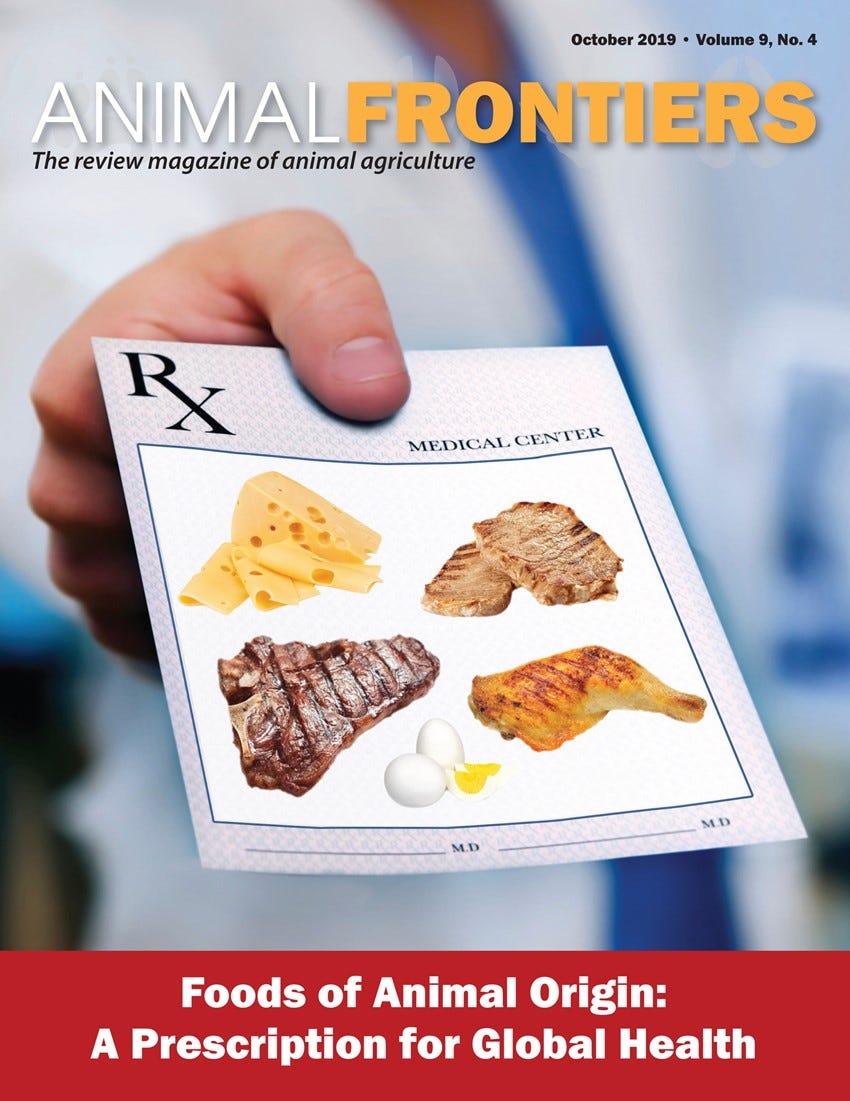
In 2019 Dr. Berg served as guest editor of the Animal Frontiers issue titled Foods of Animal Origin: A Prescription for Global Health,1 a publication that I frequently recommend. The articles it contains examine livestock and animal-source foods through the lens of human nutrition rather than production alone. Collectively, they argue that discussions of sustainability, food systems, and agricultural policy must account for the unique nutritional contributions of meat, milk, eggs, and fish—not merely their environmental footprints. The issue highlights the importance of high-quality protein, indispensable amino acids, and bioavailable micronutrients, particularly for populations most vulnerable to malnutrition, and serves as a reminder that the ultimate purpose of food systems is not simply to produce food, but to nourish people.
Dr. Berg also co-authored, with Professor Hans Stein, of one of my favorite papers: A Salute to PVT TIM HiLL: Indispensable Amino Acids and Global Human Health.2

The paper uses the mnemonic PVT TIM HILL used to learn the indispensable amino acids: Phenylalanine, Valine, Threonine, Tryptophan, Isoleucine, Methionine, Histidine, Leucine, Lysine.
While the title may raise a smile, the paper addresses one of the most important concepts in human nutrition: people do not require “protein” in the abstract. We require specific indispensable amino acids. The authors review the nine indispensable amino acids, their physiological functions, and the consequences of inadequate intake. The paper serves as a reminder that crude protein is not the same as protein quality and that foods with similar protein contents may differ greatly in their ability to meet human nutritional needs. In doing so, it reinforces the importance of amino acid digestibility, protein quality assessment, and the role of animal-source foods in supporting global human health.
Two Opportunities
This year I will participate in two sessions.
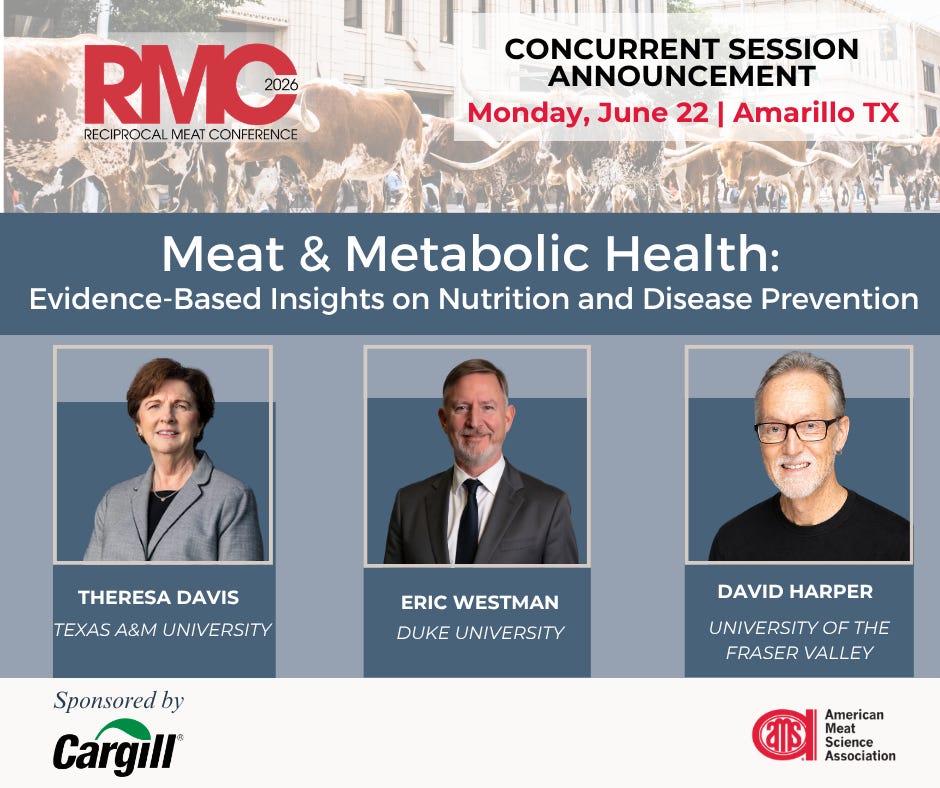
The first is moderating a panel that I organized: Meat & Metabolic Health: Evidence-Based Insights on Nutrition and Disease Prevention. The speakers and their topics are:
Professor Teresa Davis, (Texas A&M University) - Dietary Protein and Its Role in Metabolic Health
Dr. Eric Westman, M.D., MHS (Duke University Medical Center) - Role of Animal-Source Foods in the Treatment of Obesity and Chronic Disease
Dr. David Harper, Ph.D. (University of the Fraser Valley) - Evidence-Based Insights at the Intersection of Meat Consumption, Metabolic Health, and Cancer
The second is co-presenting with Dr. Harper - From “Bad Fat” to Biomarkers: Reframing Saturated Fat, Meat, and Metabolic Risk.
Our objective is to examine how assumptions regarding saturated fat and meat developed, how they influenced public-health recommendations, and how emerging evidence invites a reassessment of long-held beliefs. Both sessions represent significant opportunities to bring contemporary metabolic science into discussions about animal agriculture and food systems.
Looking Forward
A century ago, meat judging helped connect animal agriculture to food quality. Today, another bridge is needed. Agriculture and medicine. Food production and human health. Meat science and metabolic science. Those conversations too often occur in isolation—indeed sometimes opposition—from one another.
The same bridge-building effort that brings metabolic health into meat science today is one I hope to continue bringing into broader discussions of food systems, sustainability, and grassland science—including next year’s centennial International Grassland Congress in Leipzig, Germany. After all, whether we are discussing grasslands, livestock, meat science, essential amino acids, dietary guidance, sustainability, or metabolic health, the central question remains the same:
What does it actually take to nourish a human being?
Previous Posts
Readers of my recent essay, The Tyranny of Crude Protein, will recognize many of the themes discussed here: protein quality, indispensable amino acids, digestibility, and the distinction between protein on paper and protein for people.
Foods of Animal Origin: A Prescription for Global Health. Animal Frontiers, Volume 9, Issue 4, October 2019, Page NP, https://doi.org/10.1093/af/vfz042
Berg, E. P. and H. H. Stein. 2021. A Salute to PVT TIM HiLL: Indispensable Amino Acids and Global Human Health. Meat and Muscle Biology 5(3), p.4, 1 – 10. https://doi.org/10.22175/mmb.12925
I am in awe of how complicated and intertwined these sciences are. To fully comprehend the production of quality food that is truly nutritious requires understanding in so many disciplines. You (plural) have my utmost respect.
If only a small understanding of the foraging industry was common knowledge then all of humanity would be healthier and happier. This cannot be overstated. Keep up the good work.